
Agile methodologies for companies: Scrum, Kanban, SAFe, or LeSS?
More and more companies use agile methodologies (agile methods). There are many different agile methods available, and some of the most common are Scrum, Kanban, SAFe, and LeSS.
Agile methodologies in a nutshell:
Agile methodologies are flexible frameworks for managing projects. They divide work into phases, which are often defined as sprints. They emphasize continuous delivery and improvement, flexibility, and teamwork.
Traditional project management is usually based on set goals, budgets, deadlines, and implementation methods. This approach works well when the operating environment is stable. However, many modern development projects are different. For example, in a software development project, needs and goals can change during the project. In these situations, development can slow down if the company is unable to react to changing situations.
With the help of agility and agile methodologies, a company can, for example, divide work into smaller fragments, increase feedback cycles, and bring decision-making closer to teams. This makes operations more flexible. The goal of an agile team is not to avoid planning, but to make planning continuous and flexible.
When to use agile methodologies instead of tradition project management methods?
One misconception about agile methodologies is that they are automatically the best option for all situations and all organizations. However, agile methodologies are best suited for situations when outcomes cannot be fully specified in advance, or when operating environments are subject to change. Additionally, more traditional project management methods are often the better choice in situations where the product is subject to rigid legal regulation, for example.
Traditional project management methods might be more appropriate when:
the wanted end result is known in advance
there are few changes expected during the project
the schedule and budget are defined
the project is subject to strong regulation or legal requirements
Agile is particularly suitable for situations where:
new products or services are being developed
customer needs may change during development
business needs to be responsive to change
learning and experimentation are key to development
the product is continuously developed after release
In many organizations, the optimal solution is not a black-and-white, either-or choice between agile and traditional project management. Often, organizations use both in parallel across different parts of the business.
Different agile methods: Scrum, Kanban, SAFe or LeSS?
Agile is used in different ways in different organizations, as the organization's size, operating environment, and goals affect its needs. For this reason, there are also different agile methods available, such as Scrum and Kanban, which are suitable for small companies or individual teams, and SAFe and LeSS, which are suitable for larger organizations. Here we introduce these four agile methods.
Scrum: Sprint toward the desired outcome
Scrum is one of the most well-known agile methodologies. It is based on short development cycles, called sprints, during which a team works towards a common goal.
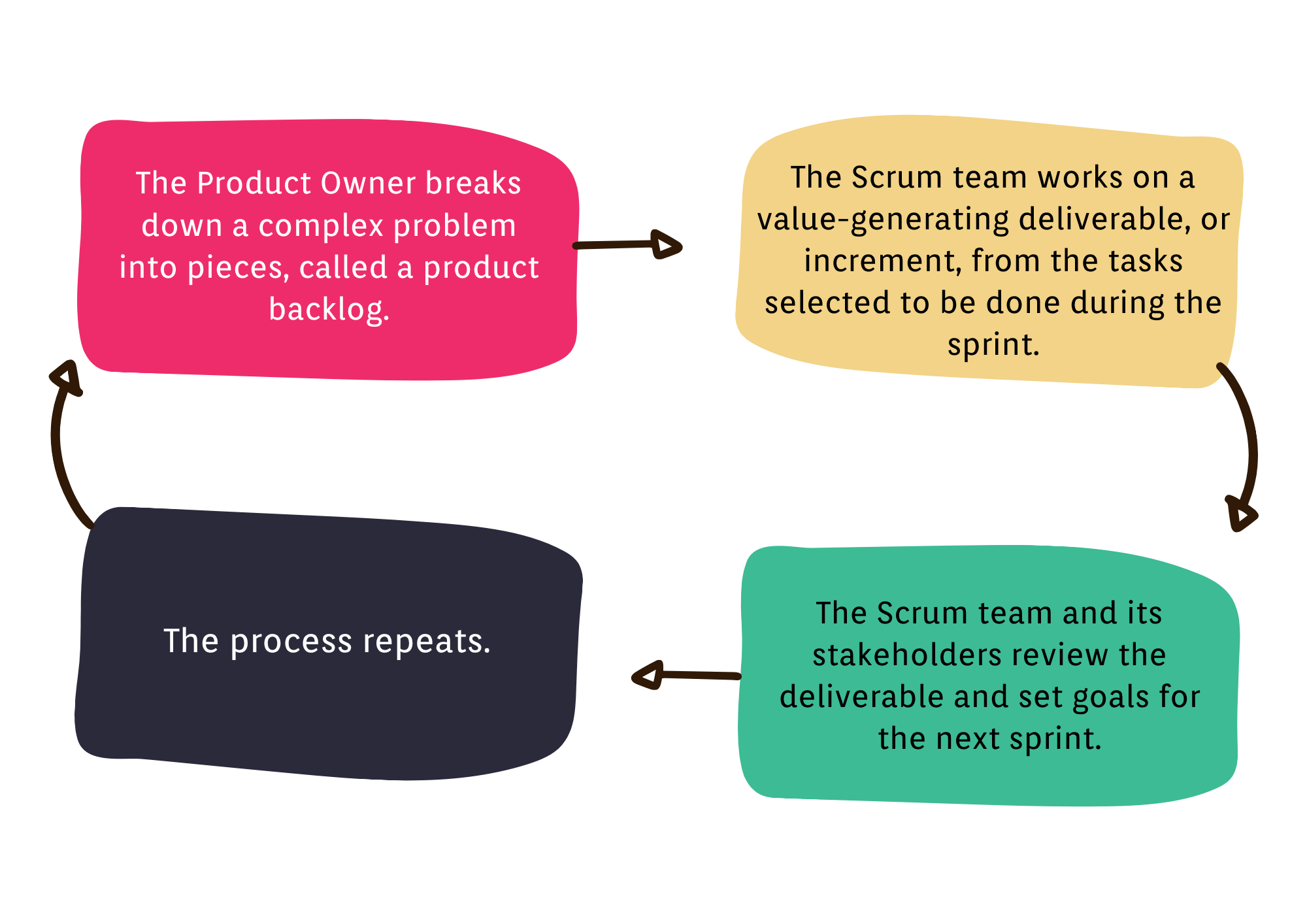
Scrum in a nutshell:
1. The Product Owner breaks down a complex problem into pieces, called a product backlog.
2. The Scrum team works on a value-generating deliverable, or increment, from the tasks selected to be done during the sprint.
3. The Scrum team and its stakeholders review the deliverable and set goals for the next sprint.
4. The process repeats.
Scrum defines three key roles:
The Product Owner (PO) is responsible for ensuring that the team produces the highest quality product possible. The PO is also responsible for the product backlog.
The Scrum Master (SM) helps the team to operate according to Scrum, for example through coaching. The SM also takes care of organizing the meetings, called Scrum ceremonies, that are part of Scrum.
Software developers do the actual development work.
→ A Scrum team consists of these roles.
Scrum also consists of certain events, or Scrum ceremonies, such as the aforementioned sprint, sprint planning, and daily, a short daily team meeting. In addition, Scrum includes sprint review and sprint retrospective meetings after the sprint, during which the results of the sprint are reviewed and the next sprint is planned.
Scrum is particularly suitable for situations where:
the development work is done by a single team
the goals may change along the way
a clear rhythm is desired
constant feedback and prioritization are needed.
Typically, a Scrum team consists of a maximum of 10 people.
More information about Scrum you can find on the Scrum Guides website.
Kanban: Manage continuous work
Kanban is one of the easiest ways to start agile development. Kanban differs from Scrum especially by not focusing on sprints. Kanban focuses on making work visible, managing the amount of work in progress, and improving work turnaround time. Kanban is not a new invention; its roots date back to the late 1940s, in Toyota factories. Kanban is a Japanese term, that translates into “signboard”, or sign.
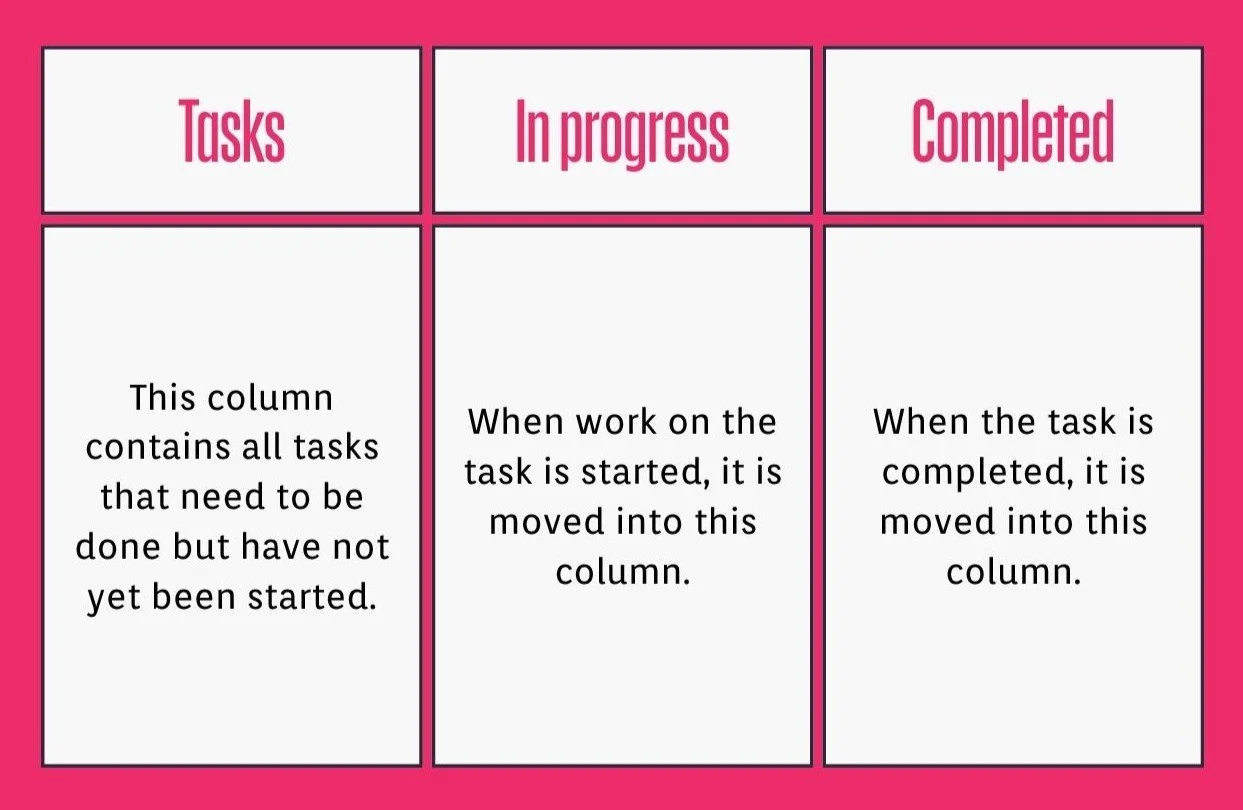
Simple Kanban board with columns for tasks, tasks in progress, and completed tasks.
At the heart of the Kanban method is a Kanban board, which is used to track the progress of work. In its simplest form, the board has three columns: tasks that have not been started, tasks that are in progress, and completed tasks. The purpose is to visualize and optimize work, measure lead times, and limit the number of tasks in progress. Kanban also sets a WIP limit (work in progress limit), i.e. the maximum number of tasks in progress, so that the team can focus on the tasks properly.
Kanban is suitable for:
for maintenance and support teams
for service organizations
for expert work
More information about Kanban can be found on the Atlassian website and Toyota’s website.
SAFe: Scale agile for large companies
Agile methods were originally developed for the needs of small companies and teams. In the context of larger companies and organizations, the challenges posed by larger teams can make it difficult to utilize agile methods. SAFe, or Scaled Agile Framework, is, as its name suggests, a framework for utilizing scalable agility. With SAFe, even larger organizations can utilize agile and lean thinking.
What is Lean? Lean is a management philosophy based on continuous development, process optimization, and customer orientation.
SAFe is built based on five disciplines of a lean-agile organization:
Lean portfolio management
Large solution integration and delivery
Product development flow
Team and technical agility
Leadership and culture
Each of the disciplines describes an essential part of an agile organization.
SAFe is suitable for situations where:
the organization has multiple development teams
there are many dependencies between teams
the connection between strategy and development needs to be strengthened
common design practices are needed
You can find more information for example on the Scaled Agile Framework website.
LeSS: Develop the same product with multiple teams in an agile way
LeSS, Large-Scale Scrum, is another example of an agile method created for large companies and teams. LeSS is based on the idea that multiple teams can develop the same product by utilizing as many original Scrum principles as possible. It highlights the importance of simplicity, transparency and continuous improvement in companies.
LeSS is divided into two versions:
Basic LeSS, which is intended for 2-8 teams (approximately 10-50 people)
LeSS Huge, which is intended for more than 8 teams (50+ people)
LeSS defines ten principles:
Large-Scale Scrum is Scrum
Empirical process control
Transparency
More with less
Whole product focus
Customer-centricity
Continuous improvement towards perfection
Systems thinking
Lean thinking
Queuing theory
Like Scrum, LeSS is based on three key roles: Product Owner, Scrum Master and Software Developers. Unlike Scrum, the Software Developer role in the LeSS framework does not refer to just one team, but to multiple development teams. In practice, LeSS utilizes Scrum, but scales it to the needs of larger companies.
LeSS is particularly suitable for companies that:
develop one main product
want to maintain a simple operating model
want to minimize redundant processes and roles
You can learn more about the LeSS framework, for example, on the LeSS.works website.
How to build an agile team?
We are the IT consultancy in Espoo. Let’s chat about your IT needs!
When implementing agile, attention is often focused on processes, tools and frames of reference. However, the success of agile in a company depends firstly on people and how the team is built. Although different agile methods offer different operating models, effective agile teams often have common features, such as multifunctionality, goal-orientedness and self-directedness.
The implementation of agile rarely fails because the chosen methodology is not suitable or functional. Problems often arise from the fact that changes are not made at the organizational level, but rather are siloed. Agile often requires a change in the company’s operating culture.
Help for utilizing agility
You can find more information on agile and different roles that can be utilized by Scrum Masters on our blog. Kimmo Muurinen, who works as a Scrum Master at Marvel Consulting, wrote a two-part blog series called Basketball Coach & Scrum Master: Same person, different roles. You can find the first part of the blog series here and the second part here. For help and more information on utilizing agile in Finnish, check out our free e-book: Ketterän tiimin rakentaminen.
We can also provide a skilled Scrum Master or Agile Coach consultant. You can contact us via our contact page or the MarCo chatbot in the bottom right corner!